

- Scope
- Full multi-page rebuild
- Status
- Concept
- Palette
FIVE STAR FOOD EXPORT
Five Star Food Export has been dehydrating and shipping food for three and a half decades. The expertise was real and deep. The website gave away none of it.
Concept project. A self-initiated redesign, made to show how this studio approaches an export business. Five Star Food Export did not commission it and the site described here was never deployed for them.
- Subject
- Five Star Food Export
- Scope
- Full multi-page rebuild
- Role
- Self-initiated — design and content structure
- Status
- Concept — not commissioned
The premise
Export buyers are not browsing. They are assessing whether a supplier is credible, consistent, and capable of holding a standard across a large order. Nothing on the old site helped them decide that.
For a business like this the raw material already exists — process documentation, product specifications, decades of operating history. It is simply rarely treated as something worth showing.
The build
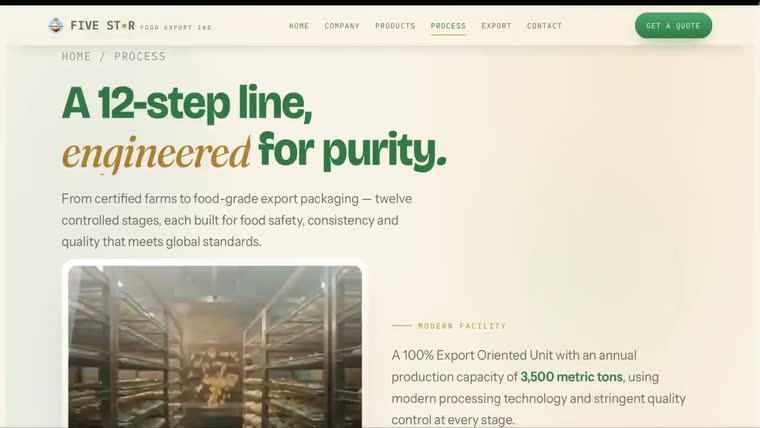
The centrepiece is the twelve-step dehydration process, rebuilt as a single scroll sequence. Each stage arrives as you move through it, in the order it genuinely happens on the floor.
The numbering here is not decoration — the process is a real sequence, so the order carries information the buyer needs. Watching the steps arrive one at a time is itself the argument for the company's rigour.
Two themes
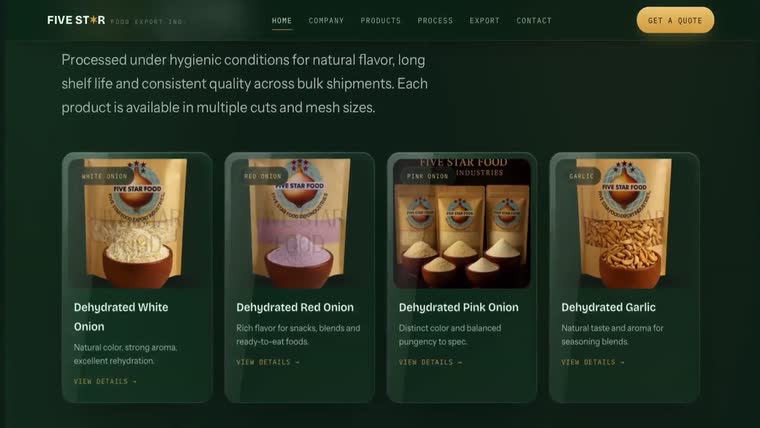
The concept comes in a dark and a light theme off the same token set — not two designs, one system with the surface values swapped. The product photography is the constant; everything around it inverts.
It matters commercially as well as visually: a buyer reading specifications on a phone in daylight and a buyer scrolling the process film in the evening are not the same reading condition, and the site does not have to pick one of them.
The detail
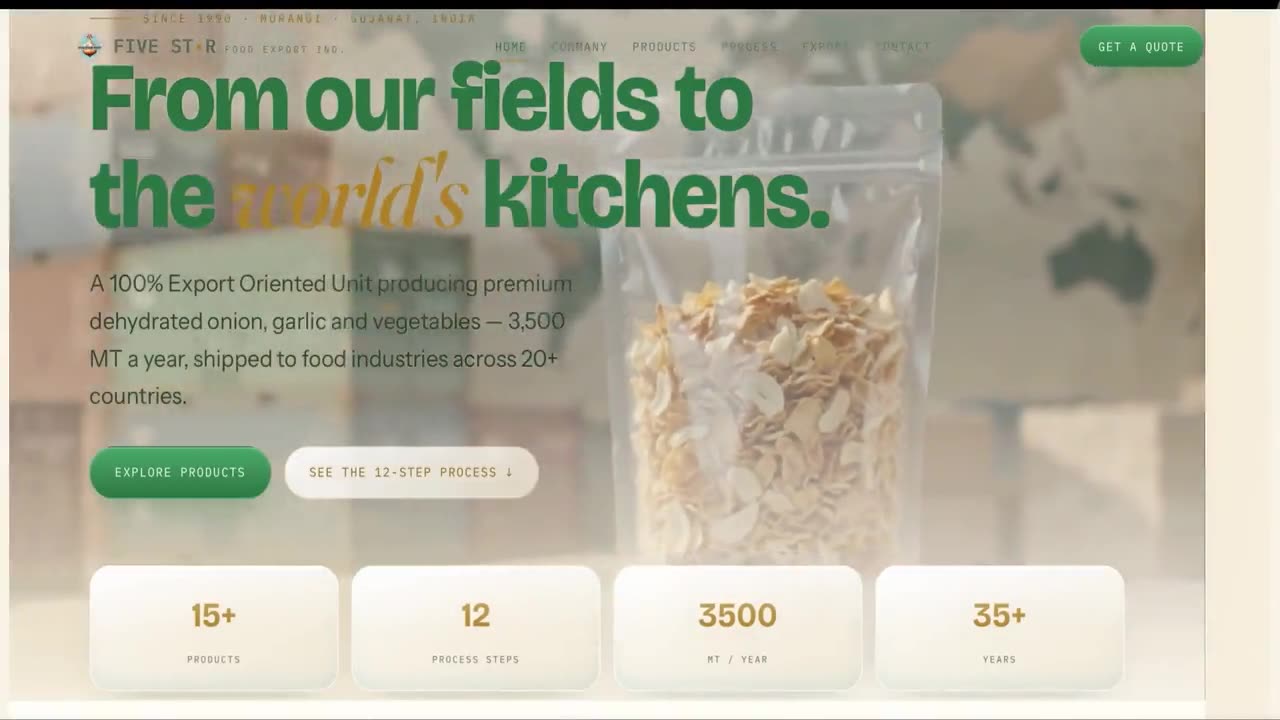
- Structured around real figures, not filler. Product count, process steps, tonnage, export reach, years in operation — the concept is laid out so that every one of those numbers has a place a supplier could fill from its own records. The point is the structure: an export buyer decides on specifics, so the design refuses to leave room for vague claims.
- A full product catalogue. Structured so a buyer can find a specification without emailing to ask for it.
- Built to be read on a phone in a warehouse. The audience is not sitting at a desk. Type sizes, contrast and tap targets were set for that context first.
What it shows
A complete multi-page concept for something most export sites never attempt: explaining, in a supplier's own terms and with its own evidence, why decades of doing one thing carefully is worth paying for.